
Seizure library
Understanding the seizure types your loved one is experiencing could be the key to uncovering a specific diagnosis. This resource was designed to help you better identify and track seizures so you can give your doctor the information they may need to provide the best care possible.
Seizure library
Recognizing types of seizures
Use the common trends you are seeing in your loved one to determine what type of seizure they may be experiencing. Use things such as the time of day, length of time, affected body part, and awareness levels to help narrow your search.
The materials included on this website are for informational purposes only—not intended as a substitute for professional medical advice, diagnosis, or treatment. Always seek the advice of your physician or other healthcare provider regarding any questions on a medical condition or treatment. Never disregard professional medical advice or delay in seeking it because of something you have read or seen on this website.

Filter by common search terms:
Filter by common search terms:
Awareness
Key part of the body
Timing/duration
Absence/petit mal seizures
(ab-sans/pe-tē-mal)
- Previously known as petit mal seizures
- Causes a short period of “blanking out” or staring into space
- During the seizure, the person's motor symptoms are minimal except for subtle ones such as eyelid flutter
- Usually affect only a person’s awareness of what is going on at that time, with immediate recovery
Common search terms:

Atonic seizures
(a-taa-nik)
- May be referred to as a “drop attack” or “drop seizure”
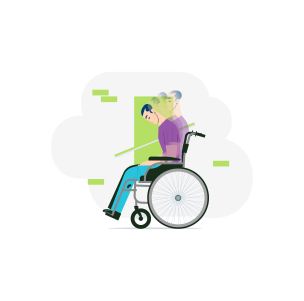
- Person has a sudden loss of muscle tone and goes limp
- Mild seizures look like a head nod or drop, while severe seizures can cause a person to fall to the ground
- People with these types of seizures may wear helmets to protect from injuries
Common search terms:
Atypical absence seizures
(a-TIP-i-kul/ab-sans)
- Period of "blanking out" or staring into space as also seen during typical absence seizures
- Referred to as "atypical" as the person may exhibit small movements such as chewing or lip smacking, and/or finger or hand rubbing
- May begin and end more gradually compared to typical absence seizures
Common search terms:

Clonic seizures
(klä-nik)
- Associated with repeated, rhythmic jerking movements lasting a few seconds to a minute that cannot be stopped by restraining or repositioning the arms or legs
- Hemiclonic seizures occur when sustained rhythmic jerking rapidly involves one side of the body at seizure onset
- Most commonly occur in babies
- Often seen as part of a tonic-clonic seizure and may be difficult to distinguish from a myoclonic seizure; however, the jerking is more regular and sustained during a clonic seizure
- May also be associated with jerking that follows stiffening of muscles, as in a tonic-clonic seizure, and can last seconds to 1 to 2 minutes
Common search terms:
Focal aware/simple partial seizures
(fō-kǝl ǝ-'wer/sim-pǝl pär-shǝl)
- Used to be called simple partial seizures
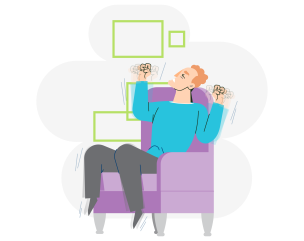
- Person is fully alert and usually able to interact
Experiences can include:
- Involuntary motor movements on one side of the body
- Intense sensory or emotional episodes, such as déjà vu or feeling unexplained emotions
Common search terms:

Focal impaired awareness/complex partial seizures
(fō-kǝl im-'perd ǝ-'wer-nǝs/käm-,pleks pär-shǝl)
- Used to be called complex partial seizures
- Person loses awareness, may not respond, and may have no memory of the seizure
Experiences vary, but can include:
- Starting with a blank stare, followed by chewing/lip smacking
- Random activity like picking at the air or clothes, attempting to pick up objects, removing clothing, repeating words or phrases, etc

Generalized tonic-clonic/grand mal seizures
(jen-rǝ-,līzd tän-i(k)-'klä-nik/grän(d)-,mäl)
- Formerly known as “grand mal” seizures. This seizure type is what most people think of when they hear the word “seizure”
- Person loses consciousness or awareness, muscles extend and become rigid, and then jerk rhythmically on both sides of the body
Common search terms:

Infantile spasms/epileptic spasms
(in-fǝn-,tī(-ǝ)l/e-pǝ-'lep-tik spa-zǝms)
- Typically occurs within first year of life, usually by 4 to 8 months
- Typically seen as a sudden stiffening of the body and brief bending forward or backward of the arms, legs, and head (can occur with limbs coming inwards toward chest, but not always)
- Face may grimace or look surprised
- Some infants arch their backs as they extend their arms and legs
- Some infants may experience head drops
- Frequently occur in clusters upon awakening or going to sleep
- May look like a startle reflex in infants
Myoclonic seizures
(MY-o-KLON-ik)
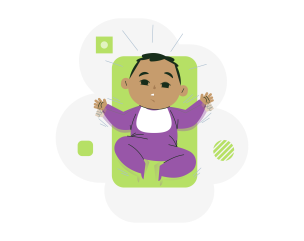
- Sudden, brief, shock-like muscle movements or jerks that usually don’t last more than a second or two
- Person is alert
- May occur in clusters and may be more pronounced upon wakening
Common search terms:
Tonic seizures
(tän-i(k))
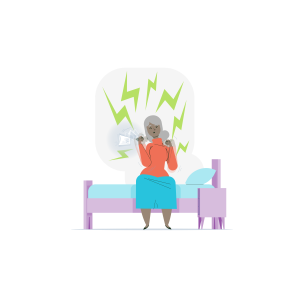
- Muscles in the body, arms, or legs suddenly become stiff or tense
- May happen during sleep, but can happen at any time of the day
- Can cause a person to fall if standing
- Typically lasts for less than 20 seconds at a time
Common search terms:
More to explore:
Learn about a treatment option for LGS
Talk to your doctor about LGS